Many founders set up a holding company to build long-term wealth and optimize taxes.
What nobody tells you is that even a simple holding still requires annual financial statements, tax returns, Bundesanzeiger filings, and ongoing compliance often costing €1,500+ per year.
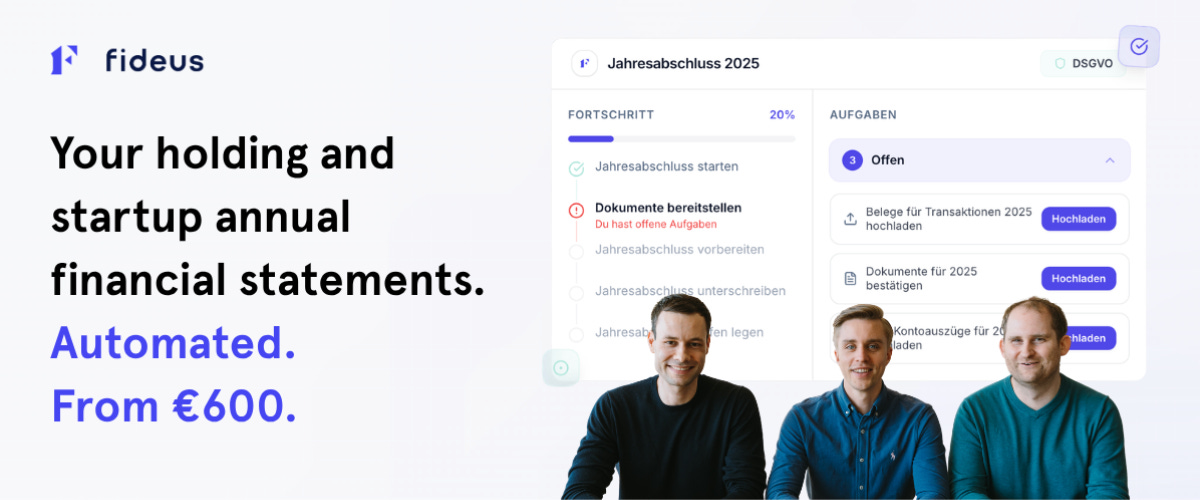
Fideus helps founders manage their holdings digitally at a transparent fixed price, starting from less than €600 annually. Less paperwork. Lower costs. Less back-and-forth with accountants.
He’s been building an e-commerce brand from scratch. Just hit $5M in revenue, completely bootstrapped.
I’m not really surprised. He’s literally a machine.
Whenever we talk about something he could do better, he just does it. A few hours later there’s an email in my inbox.
Done.
I’ve never seen someone take feedback like that and stay this hands-on at the same time.
In our last session we went a bit deeper into his personal goals.
I asked him what his ultimate goal was. Not professionally, but in life.
He said, “I want to be financially free.”
It’s not an uncommon answer. Almost every founder would say something similar.
I never fully buy it when founders say they’re building purely for impact or to change the world. Impact is great. Changing the world is great.
But when you’re building your first company, financial freedom is usually the goal.
And there’s nothing wrong with that.
It was my goal too.
When I founded my first company in 2016, I wanted exactly the same thing.
Build it. Get financially free. Then finally live.
Five-star hotels. Travel the world. Sports cars. Play golf whenever I wanted.
There was nothing wrong with those dreams.
I had all of them.
And eventually, I got there. More or less.
And for a while, it was great.
But after some time, it stopped doing much for me.
The freedom I care about today looks very different.
A lot smaller. And I think a lot healthier.
I call it “Mini Freedom”.
The reason I like the term is that there is no finish line. You don’t achieve Mini Freedom once and then have it forever.
It’s not tied to a number in your bank account, an exit, or a net worth target.
It’s something less tangible. Something you can’t buy.
For me, it’s having a little more control over my time, energy, attention, and calendar.
What surprised me most after my exit was that many of the freedoms I wanted weren’t actually that expensive.
Taking a Wednesday afternoon off.
Going for a walk.
Having breakfast without looking at my phone.
Working from somewhere I enjoy.
I could have done many of those things years earlier.
I just never gave myself permission.
Mini Freedom isn’t about doing whatever you want.
We all have responsibilities, commitments, and people who depend on us.
It’s simply about having enough space in your life to make conscious choices.
About living a little more deliberately.
About needing fewer permissions.
About creating small moments throughout the day and week where you genuinely feel free.
Sometimes it’s something as simple as sitting alone in a café on a Tuesday morning, drinking a coffee, reading a newspaper, and knowing there’s nowhere else you need to be right now.
That’s what freedom increasingly means to me.
Almost every founder I know who has already achieved financial success ends up describing freedom in a very similar way.
When I told my client some of this, he nodded.
Polite.
But I could tell it didn’t really land.
And that’s okay.
I probably wouldn’t have understood it either a few years ago.
He’ll probably keep building. Maybe sell the company.
Buy the cars. Stay in the hotels. Travel the world.
And then one day realise he’s still the same person. Just with a bigger number in his bank account.
Maybe he’ll start another company. Maybe another one after that.
Because at the end of the day the game was never really about the money.
And then, on some random Tuesday morning years from now, he’ll be sitting across from his partner at breakfast.
With no call scheduled. Nowhere he needs to be.
Nothing demanding his attention.
Just present.
And maybe he’ll realise that this was the thing he had been chasing all along.
The honest part…
What I’ve realised is that most founders don’t actually want money.
They want what they believe money will give them.
Freedom. Control. Security. The ability to spend their time the way they want.
The problem is that we often postpone those things until after the next milestone.
After the funding round. After €1M ARR. After the acquisition.
But life has a habit of moving the goalposts.
You reach one target and immediately replace it with another.
That’s why so many founders feel strangely unchanged after achieving the thing they thought would change everything.
Maybe freedom was never the destination.
Maybe it was hiding in a hundred small moments we kept postponing until someday.
So go out today and enjoy your Mini Freedom.
Have the coffee. Take the walk. Finish work an hour earlier. Call a friend or sit in the sun for ten minutes.
See you next Tuesday.
Cheers,
Xaver
PS: Want to go deeper? Become an Inner Circle member and join my private Slack community of 60+ vetted founders who’ve collectively raised $200M+ and built $50M ARR, plus my Founder OS and AI coaching replica. Explore more.
The cafe on a Tuesday morning knowing nowhere else demands your presence. That's the image that sticks. Most founders I know discovered that exact version of freedom was available years before they gave themselves permission to take it.


Some time ago, we adopted Sky Walker.
Or maybe, to be more precise, he chose us.
He was a dog without a home, but he didn’t look like a stray dog.
Happy.
Well-behaved.
Affectionate.
Free.
Since he’s been living with us, every single day he has all the freedom in the world to go wherever he wants.
We don’t keep him tied up.
He knows the neighborhood.
He loves walking around.
And he knows perfectly well how to come back home.
And yet, most of the time, he chooses to stay there.
In his little corner.
Keeping watch.
Observing.
Staying in his place.
That made me think.
Because we often imagine freedom as the possibility of doing anything, at any moment, with no limits, no responsibilities and no price to pay.
But maybe real freedom is something else.
Maybe it’s being able to consciously choose where to stay.
What to build.
What to protect.
What to let go.
And what price we are willing to pay to live the way we truly want.
The cafe on a Tuesday morning knowing nowhere else demands your presence. That's the image that sticks. Most founders I know discovered that exact version of freedom was available years before they gave themselves permission to take it.