

What if it’s enough?
One of my clients hit two million in ARR last week.

This newsletter is sponsored by Fonio.ai.
Fonio is an AI phone assistant that answers calls 24/7, handles customer conversations naturally, and resolves most requests without human intervention.
It’s already trusted by around 10,000 businesses and automates millions of calls every month all while keeping customer data in Europe and staying fully GDPR compliant.
If your business relies on the phone, it’s worth taking 3 minutes to see what modern voice AI can do.
Disclaimer: I am an investor in Fonio.ai. Want to sponsor a future edition? Click here.
One of my clients hit two million in ARR last week.
Completely bootstrapped without any investors and a team of three.
I’ve coached a lot of founders and that number with that setup is rare. Most people raise millions and hire 20-30 people to get there.
I expected him to be happy. Or at least a little proud of everything he achieved.
He wasn’t.
He got on the call and within about two minutes he was already talking about what wasn’t working.
A channel had slowed down. They needed more people. They needed to expand. They needed to scale harder.
That’s what founders typically do. They achieve a certain milestone and immediately shift their attention to the next one.
I did the same.
My company went past two million and kept going. We raised more money. We hired. We opened 5 offices in Europe. At one point we were 130 people.
And I remember the exact feeling he had on that call, because I had it for years.
I kept telling myself:
If we just hit $5M…
If we just close the next funding round…
If we just hire a few more people…
The number goes up and instead of relief you just move the finish line. two becomes five, five becomes ten. There’s always a next one and it’s always the better one.
What I didn’t understand back then is that scaling doesn’t only grow the revenue (if you are lucky). Everything else grows with it.
More people, more meetings, more management, more problems that have nothing to do with the work you actually liked doing when you started.
You stop building yourself and you start running the machine that builds the thing.
One day you look at your calendar and realize your week is filled with HR conversations, customer escalations, budgeting, and internal meetings.
You can’t remember the last time you actually built something.
Meanwhile, my client is running a two million ARR business with three people.
He can change direction in a week. He can take a Friday off without asking anyone. If he wants to kill a product and try something new, he just does it.
That’s an incredibly valuable business.
And yet he’s about to trade some of that freedom for the version of the company I once had.
I’m not saying that’s the wrong decision.
I just hope he’s making it consciously. Because from where he’s standing, scaling doesn’t feel like a choice. It simply feels like the next step.
I did ask him one thing before we hung up.
“What number would be enough?”
He went quiet.
For a few seconds, neither of us said anything.
Then he replied:
“I don’t know.”
That answer stayed with me. Because I realized I would have given the exact same answer a few years ago.
We spend years chasing bigger numbers without ever deciding what “enough” actually looks like.
We know our next revenue target. Our hiring plan. Our fundraising milestones. Our expansion roadmap.
But very few of us ever sit down and ask ourselves a much simpler question:
How big do I actually want this company to become?
Not because it will look impressive on LinkedIn. Not because people will admire me. But because it’s the business and the life I genuinely want to build.
We’re so focused on growing that we rarely stop to ask why we’re doing it.
Are we scaling because it’s what we truly want?
Or because somewhere along the way, we started believing that every successful company has to keep getting bigger?
The honest part…
I’m not asking you to slow down or be less ambitious.
The opposite, actually.
Build the thing. Give everything. Become successful.
But every now and then, ask yourself a different question. Does the company actually need to get bigger, or is it already big enough?
What if you didn’t keep chasing the next milestone?
What if you took what you’ve already built, optimized it, and focused on keeping more of what it generates instead of constantly trying to make more?
Every step of growth comes with a trade. More revenue can mean less freedom. More people can mean less time doing the work you love. More scale can mean more complexity.
None of that is inherently good or bad.
Just make sure it’s a trade you’re choosing consciously.
Cheers,
Xaver
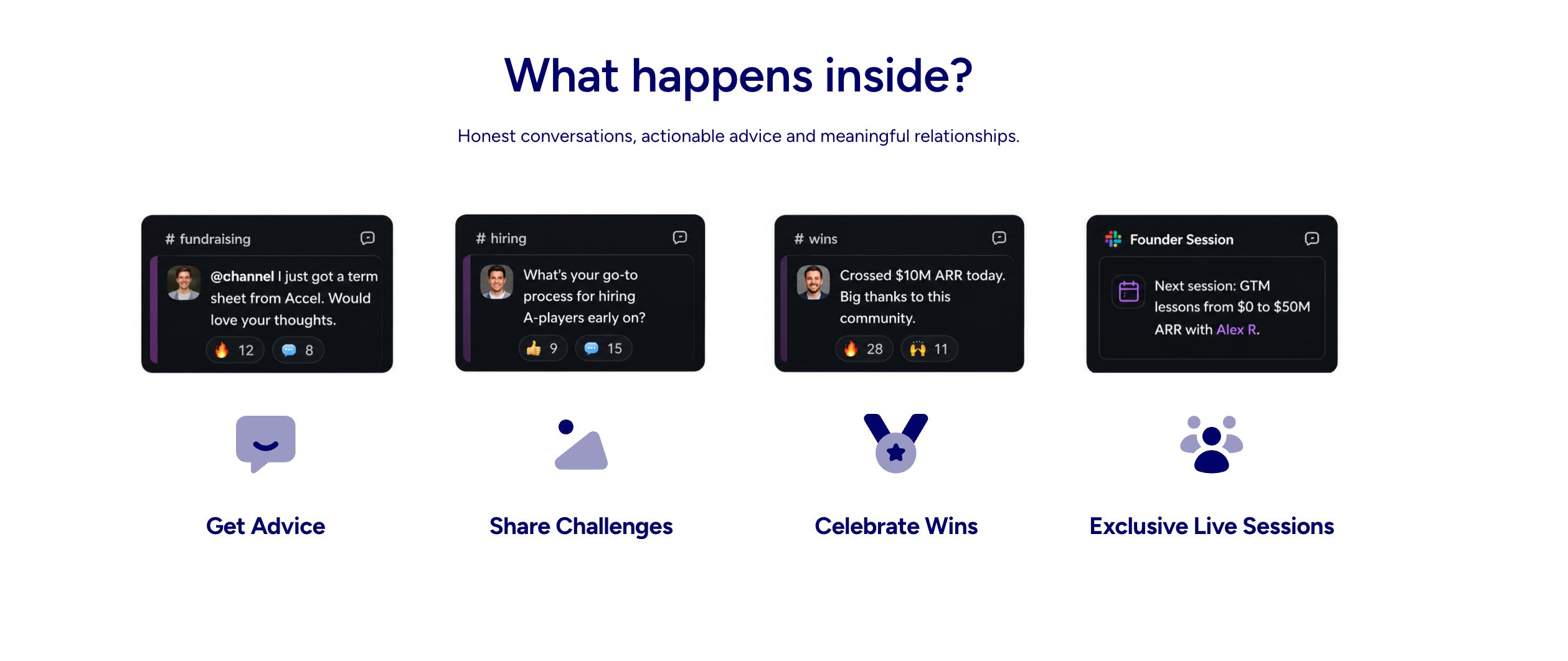
PS: Want to go deeper? Become an Inner Circle member and join my private Slack community of 60+ vetted founders who’ve collectively raised $200M+ and built $50M ARR. Check it out.
Such an important topic! Thank you for this.
It’s so necessary to keep stopping and checking in with yourself, staying aligned with your business goals but also your life goals.
So many times we forget to keep the main thing the main thing and just keep chasing, but having your North Star (a goal bigger and more powerful than financial metrics or specific business accomplishments) at the forefront can help you stay focused in the right direction.
I’ve found that establishing your North Star early on in your entrepreneurial journey is so valuable.
You won’t always be perfect at this, but remembering to come back to it is a start 💙
Why do people feel lost while building a company going on deciding what should be the moat rather doing what they actually love?
I've realized I love personally speaking to people building aggressively ambitiously and understand the persona value of the user tho on paper I'm a tech geek loving to exchange valuable thoughts is something that increases my happiness index. Everybody should find purpose and the degree doesnt justify your personality!